What do the Dutch regulations say?
The Working Conditions Decree (Arbeidsomstandighedenbesluit, Article 7.5, second paragraph) says that maintenance, repair and cleaning work on work equipment may only be carried out if the equipment has been switched off and made pressure-free or de-energised. If that is not possible, effective measures must be taken to do the work safely. Article 7.11 also asks for clearly recognisable provisions with which work equipment can be disconnected from its power source. Reconnecting must not create danger.
On its page on machine safety, the Netherlands Labour Authority gives a lock out, tag out or try out procedure as an example of a procedure for maintenance, cleaning and repair.
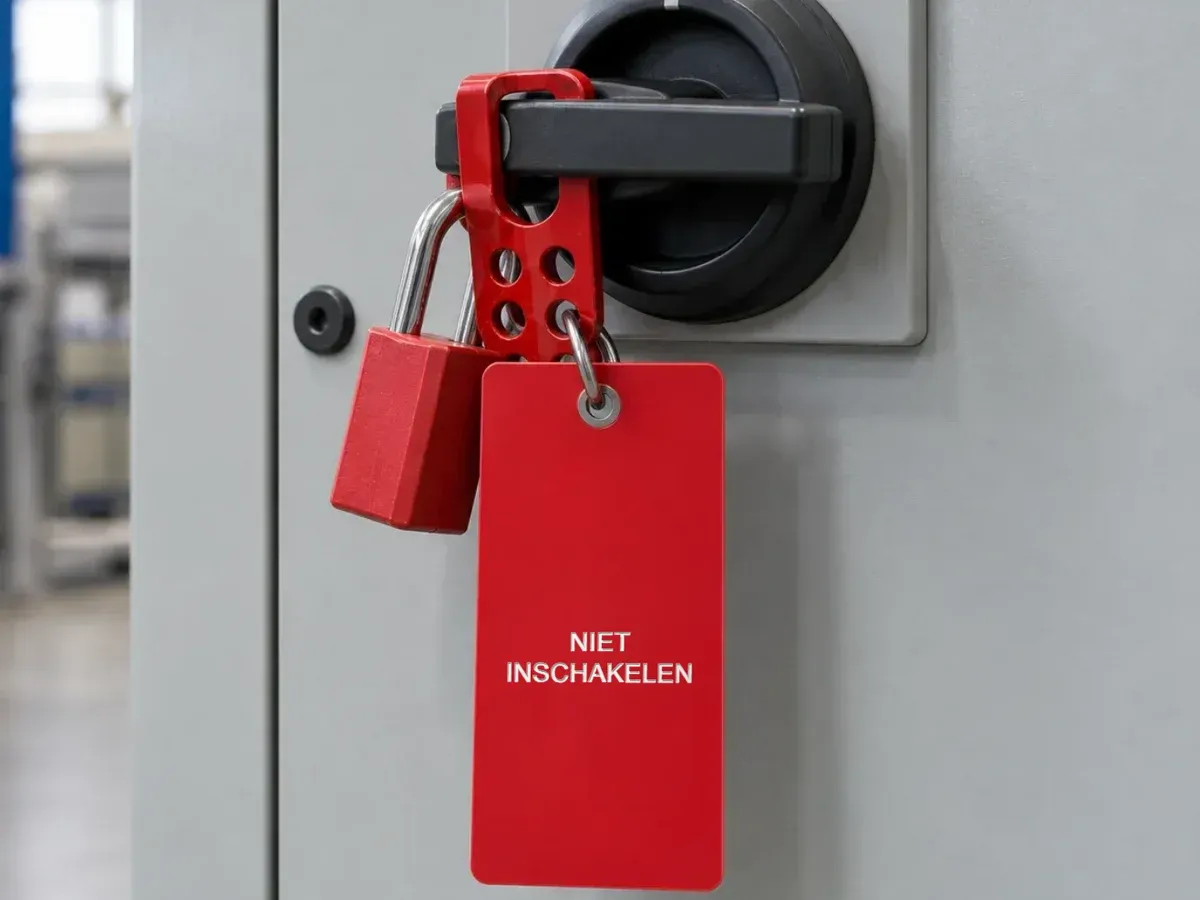
The Dutch text therefore prescribes an outcome, not what a tag looks like. What has to be on the tag is not in these sources. Your own procedure decides that.
What does OSHA say about the tag?
OSHA is the American labour inspectorate. The standard 29 CFR 1910.147 does set requirements for tags. This is an international reference, not a Dutch obligation. According to the text, a tag must:
- warn of hazardous conditions if the machine is energised, with a text such as "Do Not Start", "Do Not Open", "Do Not Close", "Do Not Energize" or "Do Not Operate";
- show who applied the tag;
- withstand the environment in which it hangs, for as long as that exposure lasts;
- be standardised within the company, in at least one of these characteristics: colour, shape or size;
- be firmly attached: the attachment means must be of a kind that cannot be reused, can be applied by hand, is self-locking and cannot be released with a force of less than 50 pounds.
OSHA also says that a tag is only a warning. It does not physically hold the switch, as a lock does.
What do you put on the tag?
On the basis of the OSHA text, this is a good basis:
- a clear instruction, such as DO NOT SWITCH or DO NOT START;
- the name of the person who applied the tag;
- a fixed design (colour, shape or size) throughout the company.
A date and the reason for the work are also useful, even though they are not in the OSHA text.
Frequently asked questions
Is a tag mandatory?
The Dutch sources we have read do not prescribe a tag. They require that the work equipment is switched off and pressure-free or de-energised. Which means you use follows from your own procedure and risk inventory.
Can a tag replace a lock?
According to OSHA, tagout may only be used instead of lockout if the switch cannot be locked and the employer can show that it is just as safe. A tag is only a warning.
Can I have my own text engraved?
Yes. You give us the text in the quote request.
Questions about this text? Email info@kuyper-graveertechniek.com or call 010 216 2344.