Which vehicles must have contour marking?
Two regulations go together here. UN Regulation No. 48 (ECE R48, consolidated text of 2021) determines which vehicles must have marking. UN Regulation No. 104 (ECE R104) describes the retroreflective material itself.
According to R48 the obligation applies to:
- trucks of category N2 with a maximum mass above 7.5 tonnes, and all trucks of category N3 (above 12 tonnes);
- trailers and semi-trailers of category O3 (above 3.5 tonnes up to and including 10 tonnes) and O4 (above 10 tonnes).
Exempt are, among others, chassis cabs, incomplete vehicles and tractors for semi-trailers. On passenger cars (M1) and trailers up to 0.75 tonnes (O1) this marking is prohibited. On other vehicles you may apply it voluntarily.
R48 names two dimensions. At the rear the obligation applies to a vehicle wider than 2.10 m. At the side it applies to a vehicle longer than 6 m (for trailers including the drawbar).
In the EU the obligation has applied to new vehicle types since 10 July 2008 and to all new vehicles since 10 July 2011 (Directive 2007/35/EC). For older vehicles you can consult the RDW.
Full contour, partial contour or line
- Line marking: a continuous line that shows the length and width.
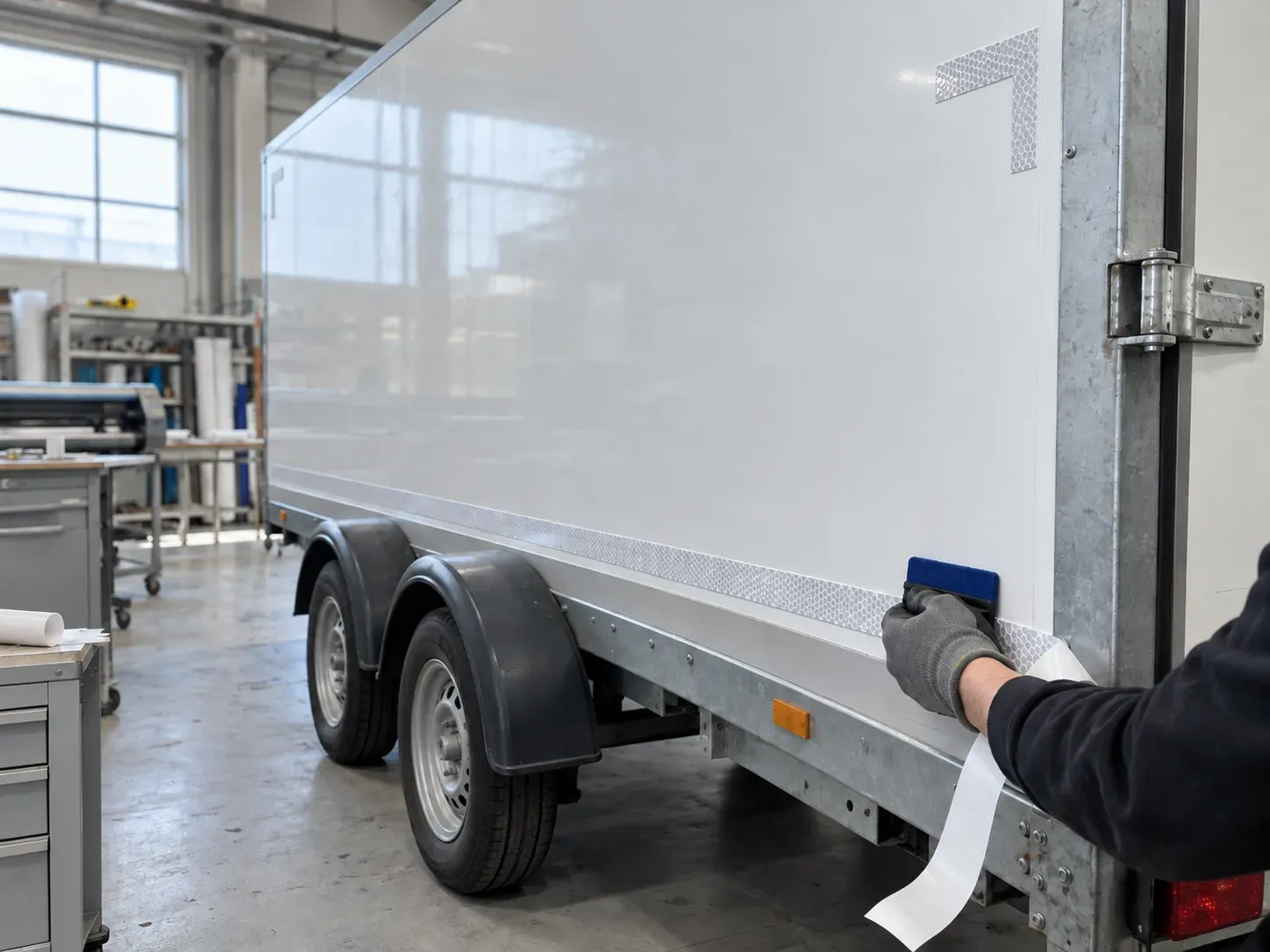
- Partial contour marking: a continuous line at the bottom, with two lines at 90 degrees at the upper corners. Each line is at least 25 cm long.
- Full contour marking: a continuous line around the whole vehicle.
R48 requires full contour marking at the rear, and partial contour marking at the side. If the shape of the vehicle does not allow this, line marking may be used. Full contour may always be used instead of a lower variant. The lowest strip is at least 25 cm above the ground.
Which colours?
R48 prescribes white or yellow at the side and red or yellow at the rear. A country may also allow white at the rear. If in doubt, choose red or yellow at the rear, or ask the RDW.
What does ECE 104 mean for the material?
R104 divides retroreflective material into classes. Class C is for contour and line marking. Class C is white, yellow or red. Classes D and E are for markings and graphics, such as a logo, and may be any colour. Film for lettering is therefore not automatically suitable as contour marking. Check that the product sheet shows the right class.
Rigid or Curtain?
We supply two versions:
- Rigid for hard walls, such as a cargo body or a box body. According to the product sheet, this is polyester with a self-adhesive back.
- Curtain for tarpaulin. According to the product sheet, this is vinyl that bends and stretches with the curtain, with a self-adhesive or heat-activated adhesive.
According to the product sheet, both versions are approved to ECE 104. The standard roll is 50 mm wide and 50 m long. You can order per metre or per roll, also cut to size.
Choose the version that suits the surface. If in doubt, state in your request which vehicle it is for.
Frequently asked questions
Which colour of contour marking must I use at the rear of my semi-trailer?
Red or yellow, according to R48. A country may also allow white at the rear; if in doubt, ask the RDW. At the side it is white or yellow.
Can I use ordinary retroreflective film as contour marking?
Not just like that. ECE R104 specifies class C for contour and line marking. Classes D and E are for markings and graphics such as a logo.
Is an approval on the product sheet also an approval of my vehicle?
No. The product sheet says something about the material. Whether your vehicle complies depends on the vehicle, the position of the marking and the date it was first put into service. The RDW assesses that.
Questions about this text? Email info@kuyper-graveertechniek.com or call 010 216 2344.